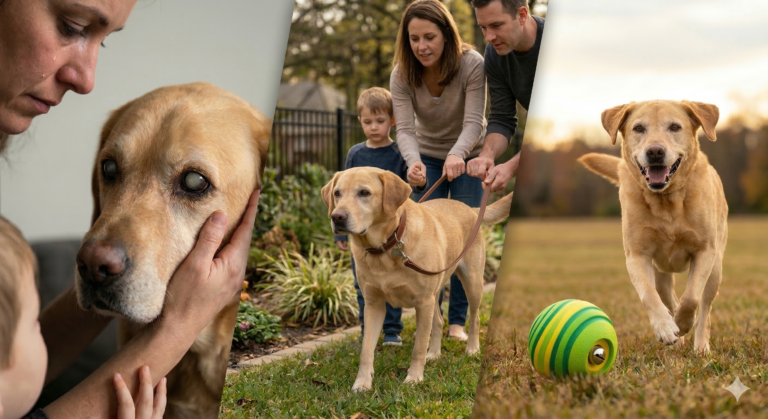
When my dog lost her sight, I panicked. I watched her bump into furniture, hesitate at every doorway, freeze in places she’d known for years. My heart broke every single time. I kept asking myself: “Is she suffering? Is she unhappy? Is this any kind of life?”
If you’re reading this, you’re probably asking the same questions right now. Maybe your dog was just diagnosed. Maybe you noticed the bumping getting worse week after week. Maybe your vet just said the words “progressive retinal atrophy” and your stomach dropped.
I want to tell you something I wish someone had told me on day one: a blind dog is not an unhappy dog. Over the months that followed, I learned about how dogs adapt, about the senses they already have that we underestimate, and about a technology called echolocation that changed everything for us.
The Moment You Learn Your Dog Is Going Blind
The diagnosis hits you like a wall. Cataracts, glaucoma, retinal atrophy, whatever the cause, the emotions are the same: fear, guilt, helplessness. You start noticing every little thing. The way your newly blind dog walks slower, sniffs the air more, stays glued to your side.
I remember thinking her life was essentially over. That she’d never run again, never explore a new place, never really be happy. I was wrong on all counts.
What I’ve learned since then is this: your grief is real, but your dog isn’t grieving the way you think. Dogs don’t mourn the loss of sight the way we do. They don’t sit around thinking about what they’re missing. They figure it out. And with the right support, they figure it out fast.
5 Signs Your Blind Dog Is Struggling (and 5 Signs They're Adapting)
Not sure how your dog is doing? These are the things I learned to watch for.
Signs of struggle:
- Bumping into furniture and walls all the time, even in rooms they know well
- Freezing in place, just standing in the middle of a room, too scared to move
- Getting clingy or anxious, following you from room to room, whining when you step away
- Not eating well or losing interest in play, pulling away from things they used to love
- Flinching at unexpected sounds or touch, because they can’t see what’s coming
Signs they’re figuring it out:
- Sniffing the air before taking a step, actively mapping their path with their nose
- Moving around more smoothly, fewer bumps, less hesitation
- Turning their head toward your voice, picking up on sounds and reacting to them
- Playing again, going after sound toys, getting excited at familiar noises
- Exploring on their own, wagging their tail in new spots, getting curious again
If your dog is still in the struggle phase, don’t panic. Most of this is temporary, especially with a newly blind dog. It usually takes somewhere between 2 and 6 months for them to adjust, and there’s a lot you can do to help.
Why Blind Dogs Are NOT Suffering
This is the question that kept me up at night: “Is my blind dog suffering?” I asked vets, I read everything I could find, I watched my dog for weeks. And the answer, from every source and from my own experience, is no.
Think about it this way:
- A dog’s world is built on smell, not sight. Their nose has up to 300 million olfactory receptors. We have 6 million. When a dog loses vision, they’re not losing the sense that matters most to them.
- Dogs don’t dwell on the past. They don’t wake up thinking “I used to see that tree.” They think “I smell that tree, I hear a bird in it, I know where it is.” That’s just how they process the world.
- Their brain rewires itself. When vision goes, hearing and smell get sharper. It’s called neuroplasticity, and dogs are really good at it. Your dog is building new pathways right now, even if you can’t see it happening.
What I’ve come to understand is that blind dog quality of life depends much more on how we react than on the blindness itself. If you stay calm, make a few adjustments, and give them the right tools, your dog will surprise you.
How Dogs Compensate: Hearing, Smell and... Echolocation?
Once I stopped worrying and started observing, I noticed something incredible. My dog was already compensating in ways I hadn’t expected:
- Her nose became her map. She could tell which room she was in by smell alone. She’d sniff the floor, the air, and know exactly where the couch was, where the door was, whether I’d just walked through.
- Her ears picked up everything. She started reacting to echoes, to the way sound bounces differently off a wall versus an open hallway. I didn’t realize it at the time, but she was already doing a basic form of echolocation on her own.
- Her paws read the ground. Carpet, tile, grass, gravel. She knew exactly where she was in the house based on what was under her feet.
That ability to use sound caught my attention. Echolocation for dogs isn’t some far-fetched idea. It’s the same principle bats and dolphins use: sound bounces off objects, and the returning echoes paint a picture of what’s around you.
And it turns out, you can actually enhance this natural ability with technology. I’ll get to that.
3 Things You Can Do Today to Help Your Blind Dog
You don’t need to turn your life upside down. These three things made the biggest difference for us:
1. Stop moving the furniture
Your dog has spent months, maybe years, building a mental map of your home. Every chair, every table leg, every corner. When you move the coffee table, you’re wiping part of that map clean. Keep things where they are. If you absolutely have to rearrange, walk your dog through the new layout a few times so they can rebuild.2. Talk. A lot.
I taught my dog five commands: “right,” “left,” “stop,” “step up,” and “watch out.” That last one, “watch out,” became the most important by far. It means “freeze, something is ahead.” Start using these now. Dogs pick them up quicker than you’d expect.And beyond commands, just talk to your dog. Tell them where you’re going. “I’m heading to the kitchen.” “I’m right here.” It sounds silly, but it cuts their anxiety in half because they always know where you are.
3. Use textures as landmarks
Put a small rug at the top and bottom of the stairs. A different mat by the back door. Your dog will quickly learn that a certain texture underfoot means “stairs coming” or “this is the way to the garden.” It becomes their own navigation system.These three things helped my dog regain confidence in about two weeks. But the real game changer was something else.
12 practical tips to help your blind dog When Technology Makes the Difference: Sound Vision
All those tips work well at home. But I still had one problem I couldn’t crack: my blind dog bumping into things every time we went somewhere new. A friend’s house, an unfamiliar park, the vet’s office. She’d freeze up or walk straight into a chair leg, and we’d be back to square one.
That’s when I started looking into echolocation devices, and the idea of giving a blind dog sound vision.
What is sound vision?
A small device clips onto your dog’s collar and sends out sound waves that humans can’t hear. These waves bounce off whatever’s nearby: walls, furniture, trees, people. Your dog picks up the returning echoes and learns to “read” the space around them. They can detect obstacles up to 3 meters away, before they walk into them.Why I ended up building Echo Smart Activ®
I tried what was available. Halo bumper rings were too bulky, and they only work on contact, meaning my dog still hit the obstacle, just with a plastic ring instead of her face. I looked at BlindSight from Jordy Canid, but it was hard to get and the technology hadn’t been updated in years.So I built what I wished existed: Echo Smart Activ®. It weighs 30 grams, clips to any collar, only turns on when your dog actually moves (that’s the Smart Activ part), and the battery lasts about 3 months. No harness, nothing bulky, just sound vision.
Quick comparison
| Halo / Bumper Ring | Echo Smart Activ® | |
|---|---|---|
| Detection | On contact | Before contact (up to 3m) |
| Weight | 150-300g | 30g |
| Comfort | Bulky harness | Clips to collar |
| Eats / sleeps freely | Restricted | Yes |
| Battery | N/A | 3 months |
If you want the full breakdown with BlindSight and Muffin’s Halo included, I wrote a detailed comparison here.
What changed for my dog
The difference wasn’t instant, it took about two weeks of getting used to it. But after that:- She stopped the careful step-by-step walking and started moving normally again
- New places didn’t scare her anymore. She’d walk into a friend’s apartment and just… explore
- At home, she finds doorways on her own, avoids closed doors, goes out to the garden by herself. Honestly, some days I forget she can’t see
I’m not going to tell you it’s magic. It doesn’t detect holes or stairs (that’s what your voice commands are for). But for walls, furniture, trees, people, anything solid in front of your dog, it works. It really works.
So, Can a Blind Dog Be Happy?
I started writing this because of a question that used to eat at me every single day: “Is my blind dog unhappy?”
After everything I’ve been through with her, after the panic, the trial and error, the slow progress, and then watching her rediscover the world on her own terms, my answer is clear.
Yes. A blind dog can absolutely be happy. Not despite the blindness. Dogs just don’t experience it the way we fear they do. They don’t feel sorry for themselves. They adjust. They find new ways. And if you give them the right support, they do more than cope. They live well.
What does a blind dog actually need?
- A stable home where things stay where they are
- Your voice as a constant guide
- Time to adjust at their own pace
- And the right tools, whether that’s rugs on the floor, scent markers, or sound vision technology
My dog runs off-leash on walks today. She explores new places. She plays, eats like a champ, and wags her tail every morning when she hears me get up. She is not unhappy. She just sees differently now.
A Note from the Author
Everything I’ve shared here comes from my own life with a blind dog. I’ve talked to vets who specialize in canine ophthalmology, I’ve read more studies than I can count, but I’m not a vet. Every dog is different, and what worked for mine might need tweaking for yours.
If you have medical concerns, please see a professional. What I can offer is my experience, my mistakes, and the things that actually helped.
Got questions? Take a look at our FAQ or the step-by-step training guide.
Your blind dog isn’t broken. They just need a little help seeing things a different way.
One Response
I loved reading your article. My Golden Retriever has retinal atrophy and is now completely blind. He is the happiest beautiful gentle soul. As a psychologist, I used my knowledge to work with him We have developed a great vocabulary, helping him to feel safe, and as I work from home, he is largely with me 24/7. He runs freely in open spaces, knows his home well, and all his regular walking routes. He walks confidently and many people are surprised he is blind, given he walks so confidently. He is such a handsome boy, which I tell him endlessly, and he receives many compliments, so he has a great ego as well!
I am about to embark on using your device – I am hopeful this will further improve his QOL!