
Blind dog help guide
Echo Smart Activ®

Trust and autonomy
Echolocation helps your dog gain confidence and explore its environment serenely.

Quality of life
The perception of obstacles promotes their mobility, helping them maintain their activity and joy of life.

Security
Proactive detection limits sudden impacts and reduces the risk of daily injuries.

Easy to use
Lightweight and compact, the device attaches in seconds and operates without complex adjustments.
Summary
- Before starting
- Discovering your Echo Smart Activ®
- Key elements of the box
- Battery, autonomy and charging
- Commissioning upon receipt
- Installation on the collar
- Positioning and orientation
- Optimizing orientation
- Checklist before use
- LED sequences and mode change
- Verification of sound emissions
- Understanding echolocation
- Learning: the 4 steps
- Learning exercises
- Maintenance and cleaning
- Water and humidity
- Quick diagnostic
- Warranty
1. Before starting
Can my dog use Echo Smart Activ® ?
For your dog to benefit from the Echo-BlindDog echolocation device, it must meet the following conditions:
- Significant vision loss: Your dog must present a substantial loss of vision, making it dependent on alternative methods to move around.
- Correct hearing: Your dog must have functional hearing to perceive the sound signals emitted by the Echo Smart Activ® system.
- Sufficient concentration capacity: Your dog must be able to concentrate enough to interpret and react effectively to the echolocation signals.
- Good general health: Your dog must be in good health, without major conditions, to ensure safe and optimal use of the system.
- Appropriate age: Your dog must be within a suitable age range. It is generally preferable to avoid use on young puppies, due to the continuous development of their spatial learning. Older dogs should be evaluated individually based on their health and adaptability.
- Absence of pain: Your dog must not be suffering. A dog experiencing pain or physical discomfort will not be able to concentrate on the echolocation signals — its attention will be mobilized by its well-being. Even a dog already used to the device may temporarily stop using it in case of pain.
What size of dog can use Echo Smart Activ® ?
Echo Smart Activ® is suitable for both small and large dogs. It is however important to note that large dogs naturally benefit from a slight advantage, as the sound signal is emitted from a higher height, which promotes its propagation. That said, the results observed in small dogs remain quite convincing.
When to use the Echo Smart Activ® ?
Every dog reacts differently! This is a crucial point that should not be overlooked: the physical and emotional state of the dog takes precedence over all learning.
As an example, the first dog to have used a prototype of the Echo Smart Activ® still possessed part of its vision, but it was gradually decreasing and it could no longer see at night or in the dark (progressive retinal degeneration). The device was therefore only put on it when the light was low, and removed during the day.
As a general rule, a dog meeting the following conditions will have a better click for the use of echolocation:
- Complete blindness for some time (no more residual vision)
- Absence of pain — no secondary painful pathology
- Functional hearing — capable of perceiving sound signals
- Shock phase passed — the dog has regained an active and exploratory behavior
- Concentration capacity — sufficiently attentive to interpret sound feedback
- Quiet environment — no noise pollution (medal, television, discussions) during the discovery
Precautions for use
When using the Echo-BlindDog echolocation system, it is essential to take certain precautions to ensure the safety and well-being of your dog.
More questions? See our FAQ
Constant supervision: even with the echolocation system, it is crucial to closely monitor your dog during its movements. The system constitutes a precious support, but the owner’s vigilance remains indispensable to anticipate unforeseen situations.
Communication with the dog: learn to interpret your dog’s signals when using the system. Observe its reactions and adapt your communication accordingly. Using Echo-BlindDog in a complex or unknown terrain requires great concentration from your dog. If it seems stressed or disoriented, double your vigilance to anticipate dangers and reassure it.
Avoid excessive noise distractions: in noisy environments, your dog might have trouble distinguishing the system’s sound signals. Avoid as much as possible high noise level areas to optimize the device’s efficiency.
Quick start
You have just received your Echo Smart Activ® ? Here are the 4 essential steps to start.
2. Discovering your Echo Smart Activ®
Echo Smart Activ® was developed with a clear objective: to offer a simple, intuitive and accessible experience to all. Designed to be used without any technical skills, the box integrates the intelligent Smart Activ function, which allows automatic activation of the signal as soon as the dog is in motion.
Thanks to this technology, we have been able to reduce the user interface to a single button: the reset one. This choice allows us to offer a product that is light, discreet and simple to get used to, both for dogs and their owners.
In this logic of maximum simplicity, Echo Smart Activ® is delivered in active operation. To stop it, simply do not move it anymore: the device then automatically goes into standby.
The 3 operating modes (from 20/11/2025)
Since 20/11/2025, all Echo Smart Activ® are delivered with a selection of 3 operating modes:
| Mode | Power | Recommendation |
|---|---|---|
| Mode 1 | Lower power sound emission | Reduced range — test if Mode 2 seems too present for your dog |
| Mode 2 | Medium power sound emission | Start here — intermediate level, ideal for discovery |
| Mode 3 | Higher power sound emission | Maximum range — always safe for hearing |
These three modes correspond to different sound levels. The higher the mode number, the more the sound intensity increases, which should improve the range of the signal. However, some dogs may better detect obstacles at lower sound levels. Others may be less comfortable with higher or lower sound levels. There is no clearly defined rule, as every dog is different. You will therefore need to adapt the best level to your dog.
To identify the most suitable mode for your companion, start using the Echo Smart Activ® in Mode 2 (intermediate). This level offers a good balance between range and comfort for the majority of dogs. Then test Mode 3 for maximum range, or Mode 1 if your dog seems more comfortable with a more discreet signal. Every dog is different: observe its reactions carefully to find the optimal setting.
Observe your dog’s reactions to each mode carefully. This progressive approach will allow you to find the ideal balance between comfort and efficiency.
Once the mode is selected, keep it in all environments. Your dog builds its detection and distance evaluation benchmarks based on a constant sound level.
A stronger signal may be more effective outdoors but cause parasitic echoes indoors. If your dog detects obstacles well outside but seems disoriented inside, lower the sound level by one step and check that the detection works correctly in both environments. The right setting is the one that works everywhere.
Installation on the dog’s collar is quick, use is autonomous, and the device works without manual intervention once positioned correctly. A 20-minute charge per month is enough to maintain the optimal sound level. Complete autonomy is 2 to 3 months depending on the dog’s activity.
3. Key elements of the box
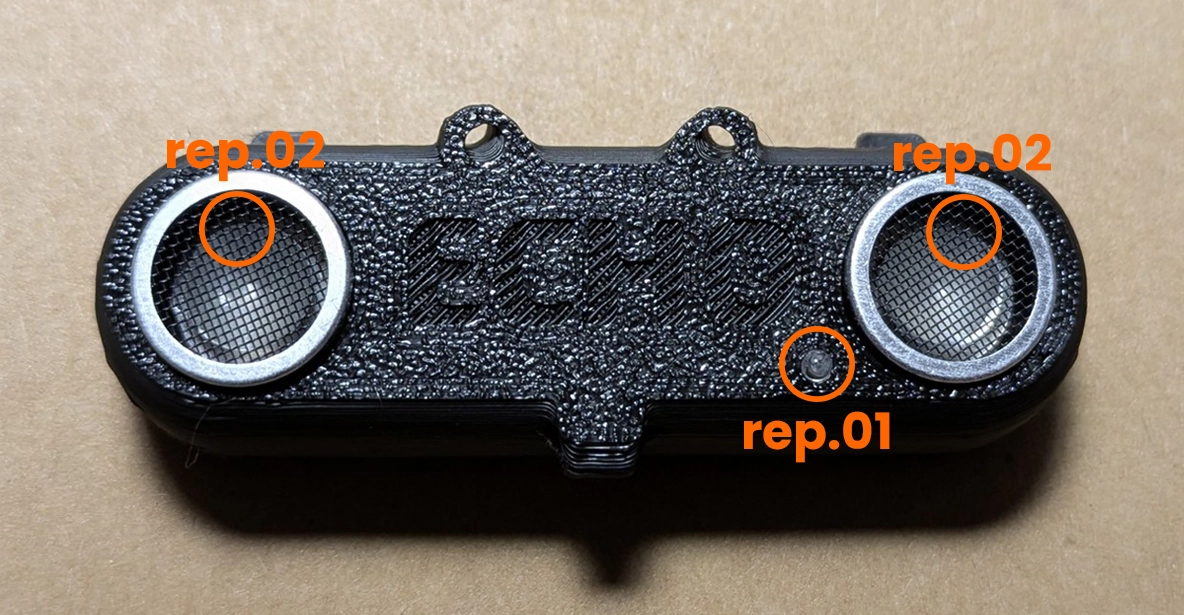
This LED indicates the correct functioning of the device. It lights up automatically during the start sequence and then flashes at regular intervals.
Functions:
- Visual confirmation of the Echo Smart Activ® start
- Regular flashing indicating that the device is functioning normally
- Assistance in diagnostic in case of anomaly
- From 20/11/2025: visualization of the operating mode (Mode 1 / Mode 2 / Mode 3)
These two metallic grids protect the emitters that generate the sound signal. Their position allows for a frontal and balanced diffusion of the signal towards the dog’s immediate environment.
Functions:
- Emission of brief sound signals when the dog is in motion
- Generation of sound only when the dog is moving
- Avoid covering or dirtying the grids: this could alter the signal diffusion.
- A stable and clear positioning improves the perception of the signal by the dog.
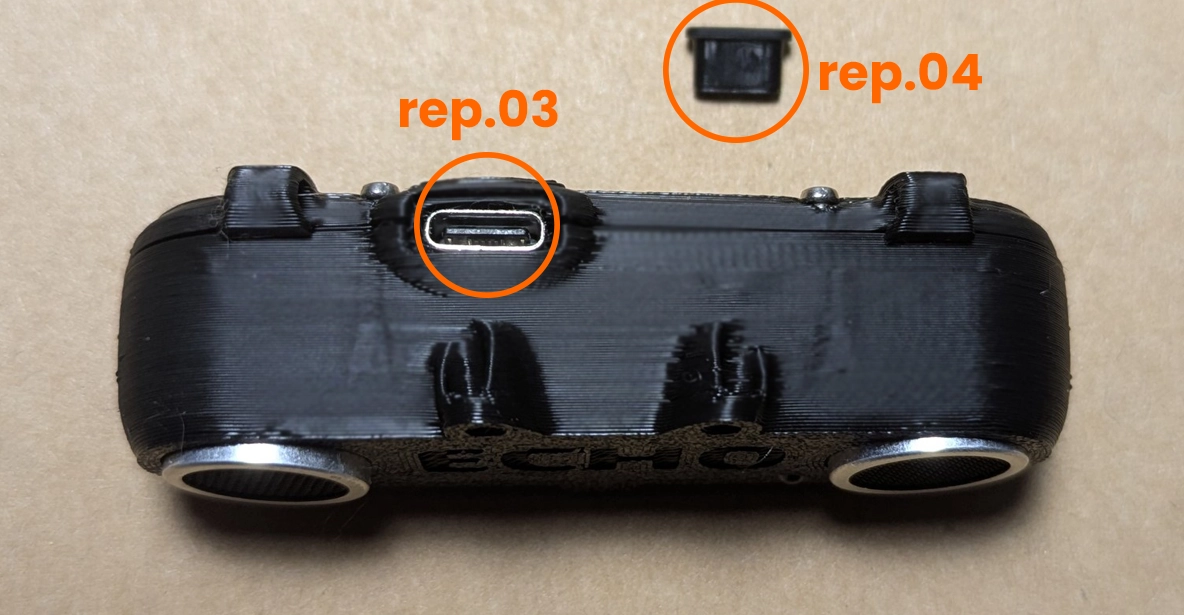
This is the main charging port for the Echo Smart Activ®. This USB-C port accepts a standard power supply of 5V — 1A maximum.
Functions:
- Recharging the device’s internal battery
- Compatible with most USB-C cables and adapters on the market
This flexible cap protects the USB-C socket against humidity, dust and projections.
Functions:
- Sealing of the charging zone
- Prevention against oxidation or fouling of the port
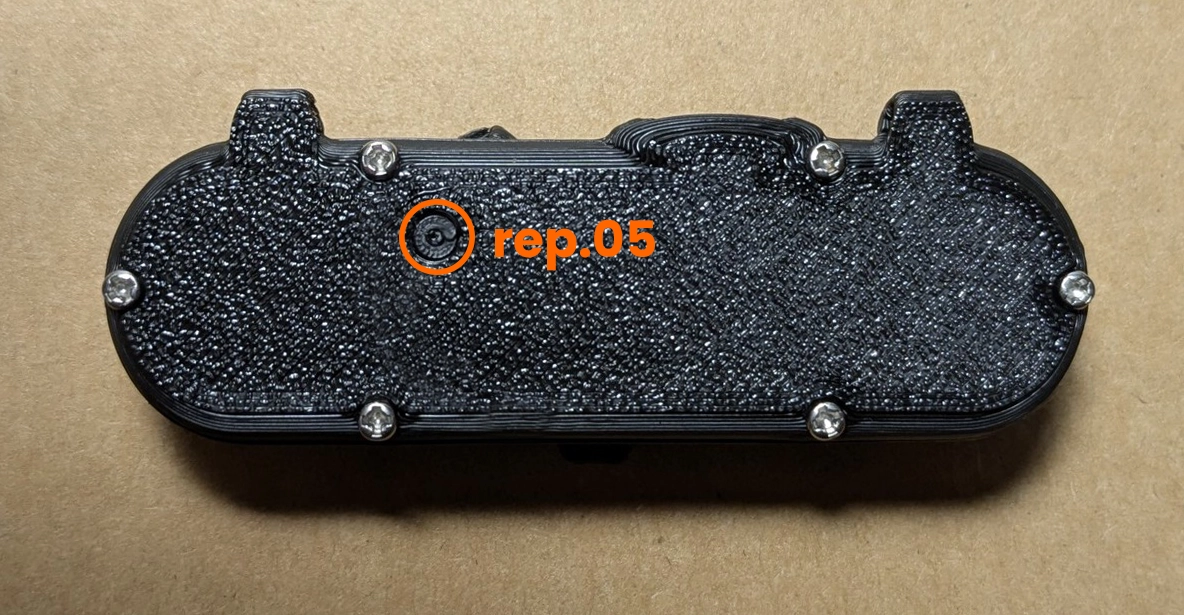
This button allows you to reset the device at any time. It is used in particular in case of malfunction or to restart the start sequence.
Functions:
- Software reset of the device
- Restart of the signal in case of interruption
- From 20/11/2025: mode change with each press
Use: a brief press (~3 seconds) on the button is enough to restart the device.
- (Before 20/11/2025) Shortly after, the LED flashes three times, indicating that the reset is effective.
- (From 20/11/2025) The LED first indicates the selected mode (Mode 1, 2 or 3), then flashes three times to confirm the reset.
A regular sequence of flashes follows, corresponding to a first automatic sequence of sound signals. You will generally observe 4 flashes or more, depending on whether the box has detected motion.
4. Battery, autonomy and charging
The estimated battery life of the Echo Smart Activ® is 2 to 3 months depending on your dog’s activity. A 20-minute charge per month is enough to maintain the optimal sound level.
The device recharges via a USB Type-C port, either with the supplied charger or with a standard phone charger (5V max 1A).
Battery safety
Safety instructions:
- Do not open, crush or pierce the battery.
- Do not expose the battery to water, fire or a direct heat source.
- Do not use the product if the battery appears swollen, leaks or is damaged.
- Do not attempt to replace the battery yourself.
This battery complies with the requirements of the UN 38.3 transport safety test. At the end of its life, dispose of the battery in accordance with local regulations and recycling procedures.
5. Commissioning upon receipt
You have just received the Echo Smart Activ® box for your dog. Here is the procedure to follow:
6. Installation on your dog's collar
Prepare the collar
Use an adjustable collar. It must be slightly loose, so that it can be put on and taken off over the dog’s head without having to open it. However, it must not be too wide.
A good indicator: during removal without opening, the collar should rub slightly on the head. This guarantees correct length and optimal height positioning of the Echo Smart Activ®.
Check and also adjust the positioning according to the diagram presented in the next chapter.
Fixing the module
Pass the collar through the side loops of the Echo Smart Activ®, as illustrated in the photo. The cord provided with the Echo Smart Activ® has been designed to ensure stable fixation, without forward-backward movement. Follow the recommended passage to guarantee a firm and secure hold of the module.

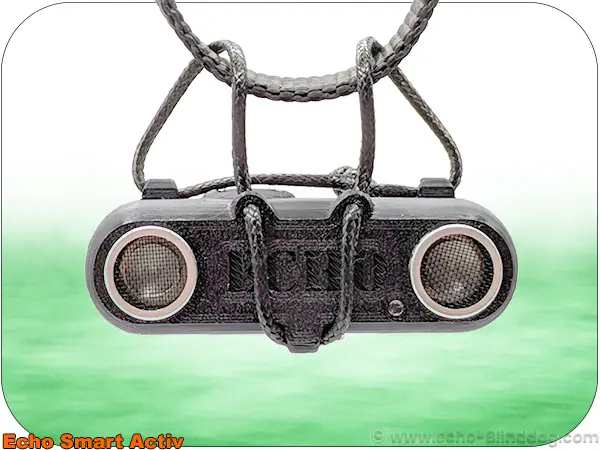
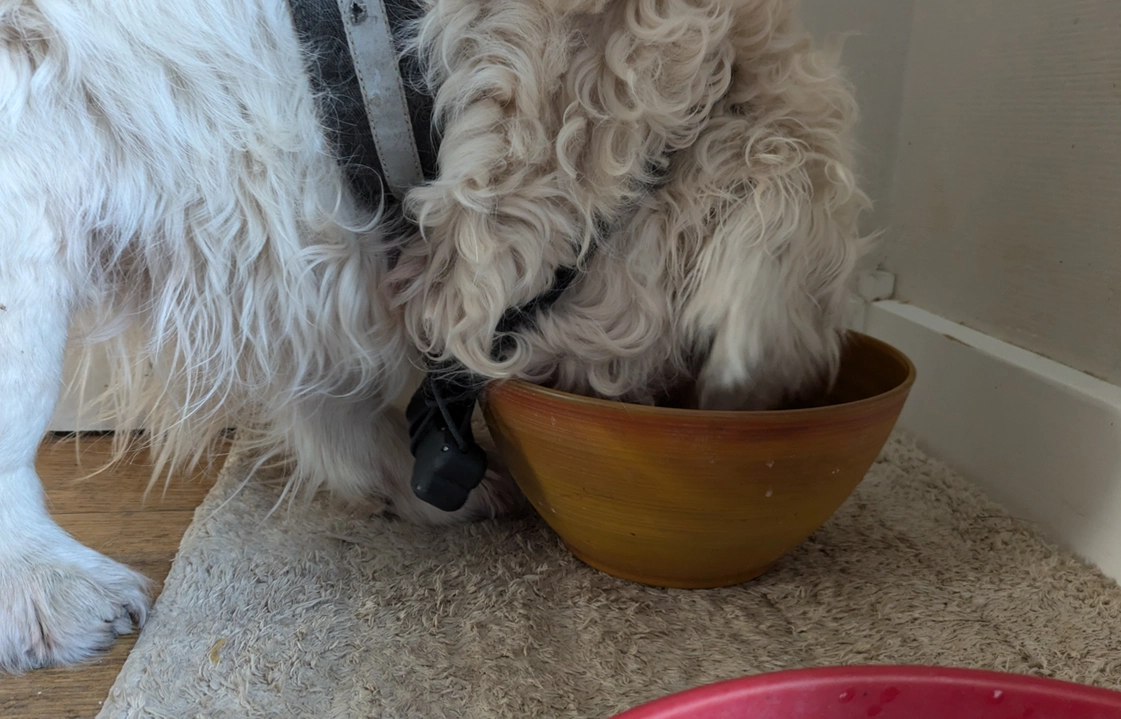
The box is designed to stay on your dog permanently, including for sleeping, drinking and eating. It is not necessary to remove it daily. The Smart Activ function automatically manages activity and rest phases.
Simply ensure that the box cannot fall into food or water (see §8. Tip 3 — Protection against water from the bowl).
7. Positioning of Echo Smart Activ®
The two round sound emitters, visible in the photo, must be oriented forward, in the axis of the dog’s muzzle. This positioning is essential for effective detection of the environment.
The diagram below illustrates the correct positioning of the Echo Smart Activ® device on your dog’s collar, highlighting incorrect placements (in red) and the correct placement (in green).
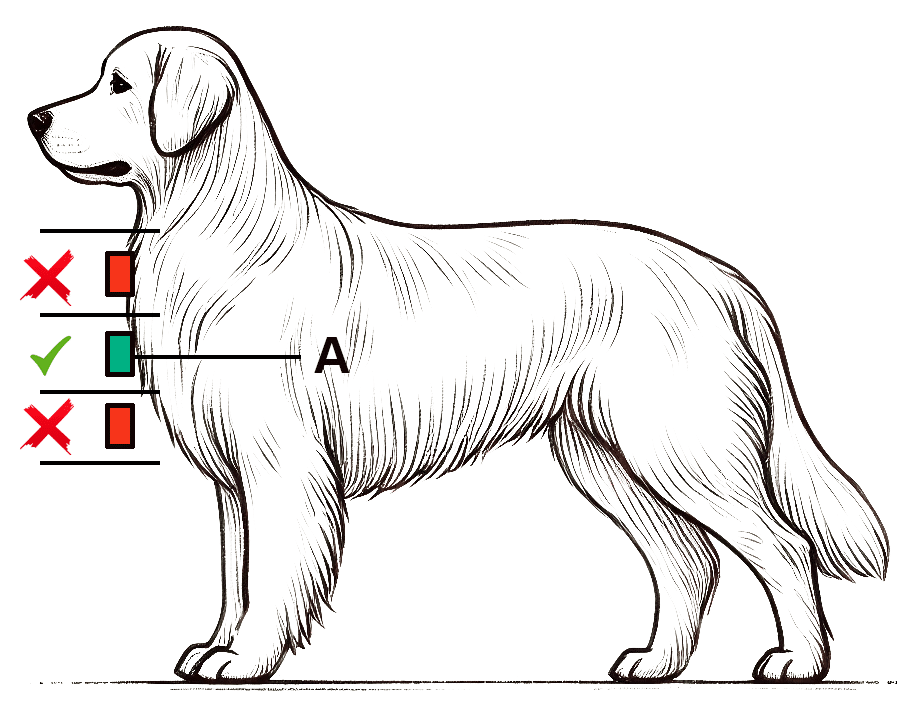
❌ Position too high
Placing the Echo Smart Activ® too close to the dog’s neck or head can interfere with the propagation of acoustic waves, making the device less effective.
✔ Correct position
The Echo Smart Activ® box must be installed at the level of the dog’s shoulders (point A). This zone is ideal to ensure optimal propagation of acoustic waves and guarantee the correct functioning of the device.
❌ Position too low
If the Echo Smart Activ® is placed too low on the chest or towards the abdomen, it risks being hindered by the dog’s movements, thus reducing its effectiveness.
8. Optimizing the orientation of the box
To guarantee maximum effectiveness of the Echo-BlindDog system, the orientation and height of the emitters are paramount. Here are the rules to follow for a correct installation.
The light beam analogy
Unlike a classic speaker that diffuses sound all around it, ultrasonic sound emitters work with a directional beam, much like a flashlight. The sound is projected in the form of a cone of about 60 degrees over a distance of 1 to 3 meters, with maximum power located at the center of this beam.
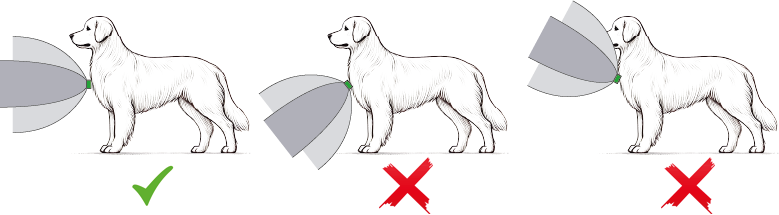
Orientations to avoid
- Oriented downwards: the signal “lights up” the ground and loses all its long-range detection effectiveness.
- Oriented upwards: the signal goes towards the sky instead of scanning the space in front of the dog.
- Too low on the chest: your dog will be hindered in its movements by Echo Smart Activ®.
- Too high on the neck: if the box is installed too high, the signals will be blocked by your dog’s muzzle, preventing the detection of obstacles in front of it.
The ideal position
The box must hang under the neck and lean against the thorax when the dog is standing. This position allows the sound to pass freely under the jaw and stay parallel to the ground.
Stability and movement
When designing the box, we took great care to place the fixings in order to offer the greatest possible stability during the dog’s movements. Obviously, the box will move slightly when your dog moves, but thanks to this design, the orientation will remain as stable as possible.
The case of sniffing
If your dog is used to walking with its muzzle down to sniff, the signals from the Echo Smart Activ® will be partially blocked. With time, it will naturally learn to raise its head more regularly to perform a duo of use: the Echo Smart Activ® for navigation and sniffing for exploration.
Quick verification
Once installed, look at your dog from the profile: the emitters must point right in front of it. Optimal orientation considerably increases the range and precision of echolocation.
Important tips
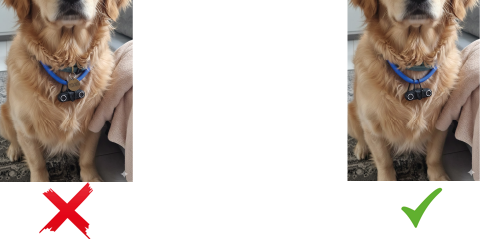
9. Verification before use
Before each use, ensure that:
- ☑ The Echo Smart Activ® is correctly positioned and oriented forward.
- ☑ The light sequence works normally.
- ☑ The collar is well adjusted and does not hinder the dog’s movements.
- ☑ The cord is well knotted, and the assembly is solid and secure.
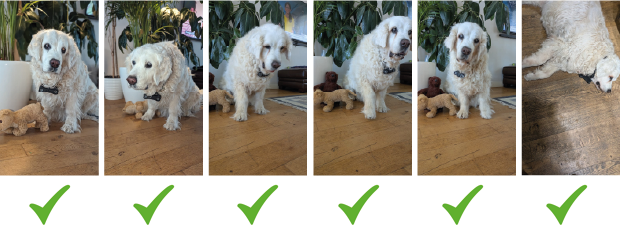
- ☑ The Echo Smart Activ® does not hinder your dog in its movements. The correct positioning corresponds to that illustrated in the photos below: the box rests against the thorax, the emitters point forward, and the assembly remains stable without hindering the animal’s freedom of movement.
10. Indicator lamp sequences and mode change
Normal operation
In normal operation, the blue LED flashes regularly when the box is in motion, then stops after a sequence of 4 or 8 flashes when it remains still. This flashing indicates that the device is active, that the sound signal is correctly generated (verifiable via the “reference phone” method), and that everything is working normally.
Fault mode
⚠
Do not use the device as long as it does not emit a normal flashing sequence.
Reset and mode change
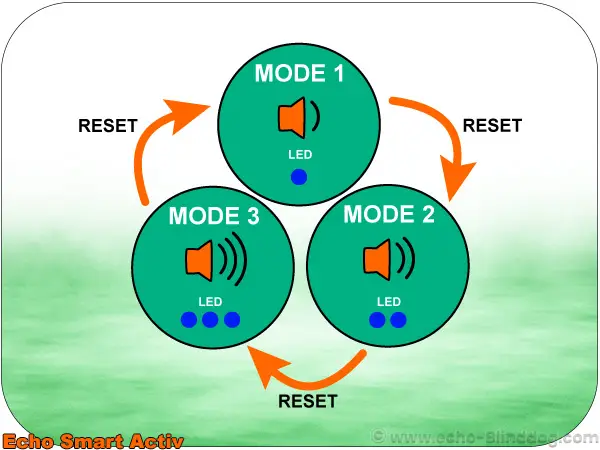
A brief press on the reset button restarts the device. Each 3-second press on the Reset button changes the operating mode: 1 → 2 → 3 → 1 → 2 …
A few seconds after this press, the LED indicates the selected mode by a light sequence:
| LED sequence | Mode | Sound level |
|---|---|---|
| 1 long flash | Mode 1 | Low sound signal |
| 2 long flashes | Mode 2 | Medium sound signal |
| 3 long flashes | Mode 3 | High sound signal |
Then the LED flashes three times, indicating a good initialization and correct communication between the different MCUs of the electronics.
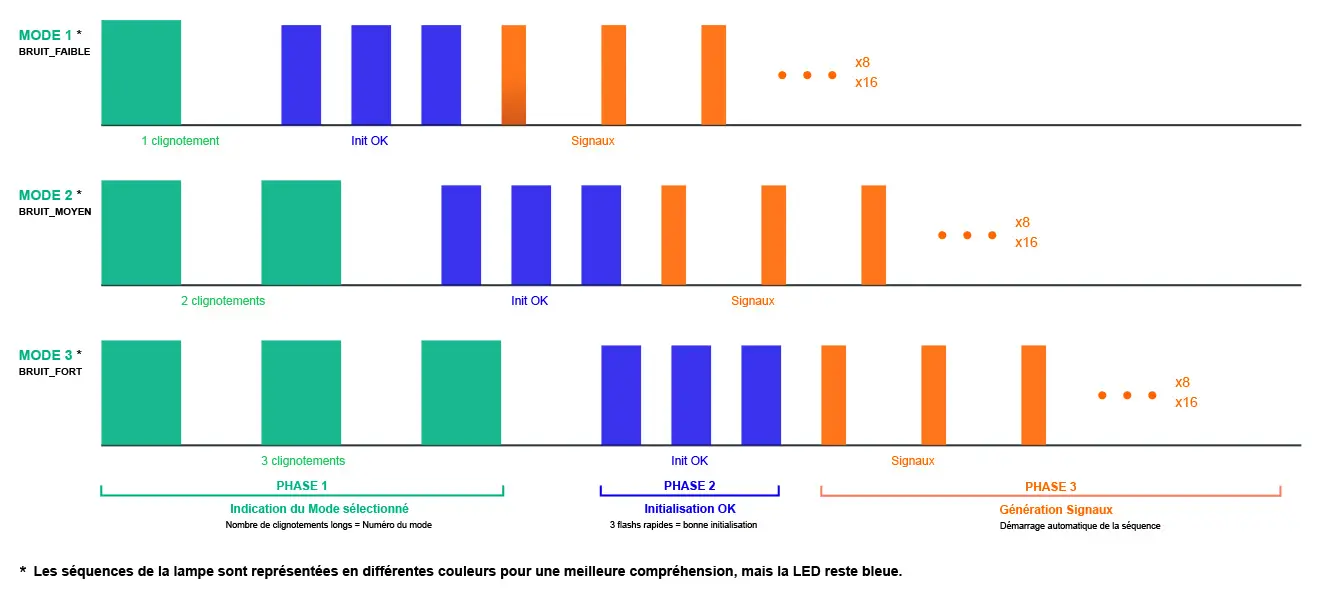
Finally, a sequence of sound signals starts automatically. This emission is viewable by a series of 4 or 8 flashes, depending on whether the box is in motion or not.
When the box is at rest, the Echo Smart Activ® automatically returns to pause mode and will resume its activity as soon as a new movement is detected.
Normal operation
In normal operation, the blue LED flashes regularly when the box is in motion, then stops after a sequence of 4 or 8 flashes when it remains still. This flashing indicates that the device is active, that the sound signal is correctly generated, and that everything is working normally.
Fault mode
⚠
Do not use the device as long as it does not emit a normal flashing sequence.
Reset
A brief press on the reset button restarts the device. A few seconds after this press, the LED flashes three times, then a sequence of sound signals starts. This emission is viewable by a series of 4 or 8 flashes, depending on whether the box is in motion or not.
When the box is at rest, the Echo Smart Activ® automatically returns to pause mode and will resume its activity as soon as a new movement is detected.
11. Verification of sound emissions — "Reference Phone" Method
I don't hear the sound of my dog's box?
That is completely normal. Echo Smart Activ® emits sounds located outside the human hearing frequency: you will therefore not be able to hear them. In order to test the box’s correct functioning, it is necessary to:
- Check for the presence of the regular blue visual indicator, which confirms that the program is running correctly.
- Check that the sound emitters are working using the “reference mobile phone” method.
If you cannot manage to find a normal flashing sequence, contact us via the contact form by describing precisely the blue LED sequence. As a precaution, do not put Echo Smart Activ® back on your dog until the problem is resolved.
Test procedure
Echo-BlindDog’s ultrasounds are inaudible to the human ear. To ensure that everything is working perfectly, you can perform this simple test using a smartphone as a witness:
You should perceive a very regular sound “tic-tic”. This quick clicking manifests as small brief sound impacts that repeat mechanically at intervals of less than a second.
12. Understanding my dog equipped with Echo-BlindDog
This section is essential so that you can anticipate and understand your dog’s reactions and detection capacities.
The principle of Echo-BlindDog is based on echolocation (or echolocation). Operation relies on the principles of sound propagation and reflection. Sound is a mechanical wave that propagates through all physical media (gas, liquid, solid). The speed of sound propagation depends on the nature of the medium in which the wave propagates, but also on the temperature.
The propagation of sound waves in the atmosphere is a complex phenomenon that can be affected by various elements, such as terrain topography, ground nature or atmospheric characteristics.
1 — The reflection phenomenon
Sound waves are reflected by the various obstacles they encounter, notably by the ground, which can sometimes transmit a sound wave over large distances. During interaction with an obstacle, part of the waves is reflected after having been modified by its surface characteristics. Reflection can be total on a smooth reflecting surface, or partial on an absorbent or rough surface. The reflected part can interact with the direct wave and create interference phenomena.
This is why your blind dog will detect obstacles better in an urban environment, and will better detect trees (hard surfaces) than bushes (soft surfaces). This is also why your dog will not be able to detect negative surfaces such as holes.
2 — The diffraction phenomenon
When a sound wave encounters a boundary presenting a discontinuity (edge of an obstacle, hole…), it is affected by a diffraction phenomenon. This results in a re-emission of the incident wave in many directions from the discontinuity. This phenomenon is very common in outdoor acoustics and notably appears at the top or edges of a wall, building or marked terrain irregularities.
This is why your dog will be able to precisely detect sidewalk or stair rises (hard surfaces + diffraction).
3 — Atmospheric effects
a — Atmospheric absorption
Atmospheric absorption depends on temperature (the hotter it is, the less important the absorption) and humidity rate (the higher it is, the less strong the absorption). This phenomenon affects high frequencies more and becomes significant over long distances.
b — Meteorological conditions
Noise propagation also depends on meteorological conditions. Sound rays can curve up or down according to wind and temperature. With a following wind, a distant noise can be heard clearly, whereas it will be strongly attenuated by a contrary wind. During a temperature inversion, sound rays curve downwards, amplifying the perceived noise. For example, after night cooling, it is possible to hear a train several kilometers away thanks to the waveguide effect.
This is why your dog will use Echo-BlindDog better on dry, hot days without wind. Conversely, rainy days, snow or wind (including fans) affect the purity of Echo-BlindDog’s sound signal.
WHAT SHOULD BE REMEMBEREDWhat should be remembered
Well detected
Walls, trees, posts, vehicles, furniture, sidewalks — any hard and clear surface reflects sound well.
Difficult detection
Thick bushes, high grass, soft and irregular surfaces — sound is absorbed and feedback is weak.
Not detected — DANGER
Holes, ditches, descending stairs, open gutters — no surface to reflect sound, therefore no detection possible.
13. Echo-BlindDog learning: the 4 steps
Your dog’s learning with Echo-BlindDog takes place progressively in four distinct steps. Every dog advances at its own pace — adapt to it, not the other way around.

1 - Discovery
The first hour

2 - Understanding
From 12h to 2 days

3 - Training
From the start to 8 months

4 - Assimilation
Beyond 8 months
Step 1 — Discovery
Habituation: the blind dog begins to discover the sound signals of Echo Smart Activ®. This is a habituation phase where it learns to familiarize itself with new sound landmarks.
Reactions: in the majority of cases, dogs do not show specific signs immediately. Their brains are however already processing the information that will become their future sound vision.
Autonomy: this step lays the indispensable foundations to accompany your dog permanently and allow it to eventually regain true autonomy in its movements.
Step 2 — Understanding
The click: this is the essential step where the dog understands the relationship between sound and obstacle. If this link is natural for 92 % of dogs, it can be more complex for the remaining 8 %.
- Post-vision loss shock: your dog is suffering from a trauma that blocks its immediate understanding. You must then take a break for a few weeks to let it calm down before starting again.
- Need for a helping hand: if your dog is not in a post-vision loss situation but does not react, it is part of the 8 % that need help. Your role is then to provoke this click by regularly practicing the exercises.
Step 3 — Training
Anticipation: supported by Echo Smart Activ® technology, the dog develops its reflexes and learns to anticipate trajectories. It transforms each signal into a mental image of its environment.
Active safety: unlike the halo or ring which remain passive, this work reinforces its sound vision. Practical exercises are a valuable asset to accelerate the transition to complete assimilation.
Well-being: by developing its cognitive capacities, the dog gains fluidity of movement. This is how it transforms technology into lasting safety and well-being daily.
Step 4 — Assimilation
Natural reflex: echolocation becomes a permanent automatism. The dog no longer reflects much on the signal: it uses it naturally to identify obstacles in real situations.
Freedom: it regains increased confidence and total freedom of movement in its daily life, as if it had found an effective sound vision thanks to the permanent wearing of the device.
Final result: integration is successful. Your dog now moves instinctively and serenely, perfectly guided by acoustic information from its environment.
These recommended durations serve as guidelines. It is essential to adapt to your dog’s individual pace, ensuring its safety, reactions and comfort throughout the learning process.
14. Learning exercises
Accompanying your dog towards the “Click” with the Echo Smart Activ®
The importance of the click is absolutely fundamental, as it is the precise moment when the dog’s brain switches from passive hearing to active perception of its environment. Before this click, the Echo Smart Activ® signal is only background noise without utility, a sound information that the dog ignores or undergoes. The click is that spark of understanding where the animal finally realizes that the return of the sound signal is the physical representation of an obstacle in front of it. It is the indispensable starting point that transforms a technological object into a true substitute sense.
Without this awareness, no progress is possible. But once this link is established, the dog stops undergoing its handicap to start “seeing” with its ears, thus opening the way towards regained autonomy and a significant reduction of its daily stress.
However, every dog is unique: for some, understanding is immediate; for others, the process requires help and patience. In some cases, deep blockages can make learning very complex, even impossible. This section is here to help you cross the crucial “click” stage.
1. Understanding your dog's situation
The way your dog lost its sight directly influences its emotional state and its capacity to learn:
Sudden loss (SARDS, Acute Glaucoma)
The dog is often in a state of shock or panic. This intense stress can block learning. You must first reassure it before starting the exercises. Every dog is different, but the Echo Smart Activ® can very well help during this phase, or have no effect.
Progressive loss (Cataract, PRA)
The dog has already started to compensate with its other senses. It is often more receptive and ready to integrate the Echo Smart Activ®.
Residual vision
If your dog still perceives shadows or light, it will ignore the echo to trust its eyes, even if they fail it. The main risk is that it will end up considering the Echo Smart Activ® signals as mere background noise and no longer pay attention to them afterwards. Therefore, do not leave your dog equipped if you do not notice any reaction on its part (quick head movement in front of an obstacle, avoidance, or any other reaction showing that it is using echolocation).
Post-vision loss stress
A dog losing its sight undergoes a sensory trauma. If it freezes or refuses to move, it is not bad will, but deep insecurity. This shock phase can be more or less long according to the dogs, from 2 months to 1 year.
Some dogs benefit from the Echo Smart Activ® during this phase — for example if they seem more confident in their movements, less stressed, or if they find their water bowl more easily. In this case, leave them the equipment. Conversely, if no positive effect is visible quickly (within a day or two), it is better to remove the device temporarily to avoid passive habituation to sounds, then re-equip the dog once this phase has passed.
General health state
If it suffers or feels physical discomfort, your dog will no longer be able to focus on echolocation. Even a dog that has already had the click and uses the device perfectly may stop using it temporarily during these phases of pain. Its attention is then mobilized by its well-being, which makes the processing of sound signals secondary.
As a general rule, a dog completely blind for some time, and suffering from no secondary painful pathology, will have a better click for the use of echolocation.
2. Ideal conditions to begin
Before starting the exercises, it is indispensable to isolate your dog’s hearing so that it can focus on the device’s signals:
Technical verification: confirm that the box works (blue LED) and set it to sound level 2 (intermediate).
3. Exercises to create the sound connection
The objective is to help the brain understand that the echo return means the physical presence of an object. The use of positive rewards (treats, caresses, congratulations) is essential to motivate the dog and validate its cognitive efforts.
Exercise 1: The Corridor
The walls of a corridor, being hard and large, produce strong and constant echoes. It is the ideal environment to begin.
- Place your dog at one end and call him from the other end.
- If he approaches a wall, the echo will be stronger, informing him of the obstacle’s proximity.
- Do not guide him too much with your voice. Repeat the exercise while moving from right to left along the corridor’s axis until he detects the walls and corrects his path on his own.
- Systematically reward each successful attempt.
Exercise 2: The contrast
- Place a large thick and rigid cardboard on one side of the hallway.
- Call your dog. If it slows down, stops or turns its head sharply to avoid the obstacle, it’s because the message is starting to get through!
- Congratulate it immediately in a very positive manner.
Exercise 3: Radical sound difference
The objective: make it understood that signal return = presence of an obstacle.
- Free path: call your dog in a free trajectory (open space without obstacle) so it experiences the absence of echo return. Reward upon arrival.
- Repeat immediately with a large cardboard placed in the center of the trajectory. Do not warn your dog — it must assimilate the signal difference.
- Let it discover that: signal return = presence of an obstacle.
- As soon as it shows hesitation or avoidance (even if it touches the cardboard), offer an exceptional reward.
4. Observations and session duration
✔ Signs of progress to observe
- Ears pivoting towards the echo source
- Slowing down before the obstacle
- Head turning (sound scanning)
- Voluntary change of trajectory
❌ Signs of stopping (too much stress)
- It freezes and refuses to advance
- It trembles or pants from stress
- It seeks to flee the exercise
Practical advice
Duration: favor sessions of 3 to 5 minutes maximum, several times a day. Analyzing echoes is a nervously exhausting exercise at the beginning.
Tactile anchoring: if the link is not made, bring your dog in front of the cardboard, let it perceive the echo, then have it touch the object with its nose to link hearing to touch. Always reward to soothe the dog.
5. After the click: assimilation phase
Once the click is made, your dog enters an evolution phase that generally lasts a few months. Its brain will progressively refine the signal reading. Imperatively maintain rewards (at least verbal), as the cognitive effort remains intense during the first months.
Congratulating each successful avoidance allows anchoring the Echo Smart Activ® as a pleasant automatism. Be patient and stay constant in your encouragement.
15. Maintenance and cleaning
Piezo-electric emitters are essential components of the Echo Smart Activ® system. Regular maintenance is necessary to ensure their correct operation and prolong their lifespan.
Regular cleaning
Avoid dirt accumulation: emitters can accumulate dust, dirt or other particles. Use a dry brush and a soft, dry cloth to delicately clean the external surfaces of the emitters.
Do not use solvents or other products: do not use aggressive chemical solvents, alcohol or other substances likely to damage the emitters’ surfaces.
Visual inspection
Check physical condition: regularly perform a visual inspection of the emitters to detect any sign of damage, crack or excessive wear.
Protection against humidity
Avoid prolonged exposure to humidity: although the system is weather-resistant, avoid prolonged exposure to excessively humid environments, as this could affect the emitters’ performance.
Use and drying in rain or high wet grass
If your dog’s behavior changes during a walk: if the emitters are wet, their sound emissions can be strongly altered. Blow strongly on the emitters to drive away the excess water or humidity so that your dog regains its sound assistance. Repeat the operation as many times as necessary.
Dry carefully after use in the rain: if the system is used in the rain, ensure you dry the emitters and receivers carefully after each use to avoid any damage due to humidity.
Periodic test
Perform functional tests: periodically, perform functional tests (reference phone method) of the system under controlled conditions to ensure that emitters and receivers are working correctly.
By following these maintenance recommendations, you will guarantee optimal functioning of the piezo-electric emitters and receivers, thus contributing to the global performance of the echolocation system for blind dogs.
16. Water and humidity
Water
Humidity
Although the system is resistant to normal weather conditions, prolonged exposure of the piezoelectric transducers to humidity can temporarily affect the box’s sound performance.
Dry carefully after use in the rain: if the system is used in the rain, ensure you dry the emitters carefully after each use to avoid any damage due to humidity.
17. Quick diagnostic
| Symptom | Probable cause | Solution |
|---|---|---|
| The blue LED blinks regularly | Normal operation | No action needed ✔ |
| The LED blinks 3 times then turns off | Low battery | Recharge your Echo Smart Activ® (USB-C, 5V 1A max) |
| The LED blinks very fast / irregular rhythm | Software malfunction | Perform a reset (press 3 sec). If the problem persists, fully recharge then test again |
| The LED does not light up at all | Completely discharged battery or hardware failure | Fully recharge. If no result, contact support |
| The dog no longer reacts to obstacles | Wet or dirty emitters | Blow hard on the emitters. Clean with a dry cloth if necessary |
| The dog seems bothered or stressed by the Echo Smart Activ® | Unsuitable sound level or poor positioning | Reduce the sound level (Mode 1). Check the positioning and orientation of the device |
| The “phone test” picks up nothing | Phone microphone unsuitable or emitter failure | Test with another smartphone model. If no phone picks up the signal, contact support |
| Poor detection outdoors | Strong wind, rain, humidity, or poor emitter orientation | Check the device orientation. Wait for better weather conditions if necessary |
18. Warranty
Warranty exclusions
- Normal wear and tear: scratches, traces of use, slight discoloration related to daily use.
- Non-compliant use: damage resulting from use contrary to the instructions in this manual.
- Accidental damage: shocks, falls, immersion in water, exposure to extreme temperatures.
- Deterioration by the animal: bites, scratches or any damage caused by the carrying animal.
- Battery and emitter wear: natural decrease in capacity over time.
- Unauthorized modifications or repairs: any intervention carried out by the customer or an unauthorized third party.