
Your blind dog just walked into the coffee table again. You watched it happen, and even though it wasn’t the first time, it still stings. You want to help, but you’re not sure what actually works and what’s just wishful thinking.
Why Your Blind Dog Bumps Into Things (It’s Not What You Think)
When a sighted dog walks through your house, they see the couch, the doorframe, the table, and they adjust on the fly without thinking. When vision goes, that whole system disappears. Your dog is left navigating with smell, memory and hearing alone.
Home Setup: Make Your Space Blind-Dog Friendly
Tip #1: Stop moving the furniture
This is the single most important thing you can do. Your blind dog has a mental map of every chair, table, and doorway. Move the coffee table six inches to the left and you’ve just put a wall where there wasn’t one. If you absolutely have to rearrange, walk your dog through the new layout on a leash, slowly, letting them sniff and bump gently until they’ve got it.Tip #2: Block the danger zones
Stairs, balconies, pools, open fireplaces. These are the spots that can actually hurt your dog. Put up baby gates at the top and bottom of stairs until your dog learns to navigate them with voice commands. Fence off pools permanently. Cover sharp furniture corners with foam bumpers, the kind parents use for toddlers works perfectly.Tip #3: Keep their stuff in the same spot
Water bowl, food bowl, bed, favorite toys. Always in the exact same place. Your dog finds these by memory and smell. If you move the water bowl to a different room, your dog might spend 20 minutes looking for it and get stressed in the process. Consistency is everything.Scent Markers and Texture Cues
Tip #4: Use different textures as landmarks
Put a small rug at the bottom of the stairs. A rubber mat by the back door. A piece of carpet at the entrance to the kitchen. Your dog’s paws are incredibly sensitive. Within days, they learn that a specific texture underfoot means “stairs ahead” or “this is the way outside.” It’s cheap, it’s simple, and it works better than almost anything else I tried.Tip #5: Consider scent markers (but test first)
Some guides recommend placing different scents at key spots: vanilla near the back door, lavender by the bed, that kind of thing. The idea is that your dog uses smell to identify locations.Voice Commands Every Blind Dog Should Know
Tip #6: Teach 5 essential navigation commands
These are the five that made the biggest difference for us:- “Watch out” — freeze, something is ahead. This one saves them from collisions daily
- “Step up” — a curb, a step, or a threshold is coming
- “Step down” — the ground drops ahead
- “Left” / “Right” — gentle directional nudges on walks
- “Free” — the path ahead is clear, you can walk normally
Tip #7: Narrate your life
This sounds ridiculous, but it works. “I’m walking to the kitchen.” “I’m right here.” “Someone’s at the door.” Your blind dog can’t see where you went. When you disappear silently, their anxiety spikes. When you keep a running commentary going, they always know where you are, and they stay calm.5 Daily Exercises to Build Your Blind Dog’s Confidence
Tip #8: The treat trail
Drop a line of treats from your dog’s bed to the kitchen. Let them follow their nose. Next day, make the trail a little longer, around a corner, through a doorway. You’re teaching them to trust their nose as a navigation tool. Within a week, most dogs are walking these routes on their own without the treats.Tip #9: Sound games
Tap the floor in different spots and let your dog come to the sound. Roll a ball with a bell inside it across the room. Clap near a doorway so they learn where it is. These games strengthen the connection between what they hear and where things are. And dogs love them, mine got more excited about sound games than she ever did about fetch.Tip #10: The explore walk
Once a day, take your dog on a slow, no-agenda walk. Let them stop wherever they want, sniff whatever they want, take as long as they need. No pulling, no rushing. This is their time to process the world through smell and sound. For a newly blind dog, these walks are therapy. They learn that the outside world isn’t scary, it’s just different now.The Technology Solution: Echolocation for Dogs
Tip #11: Give your dog sound vision
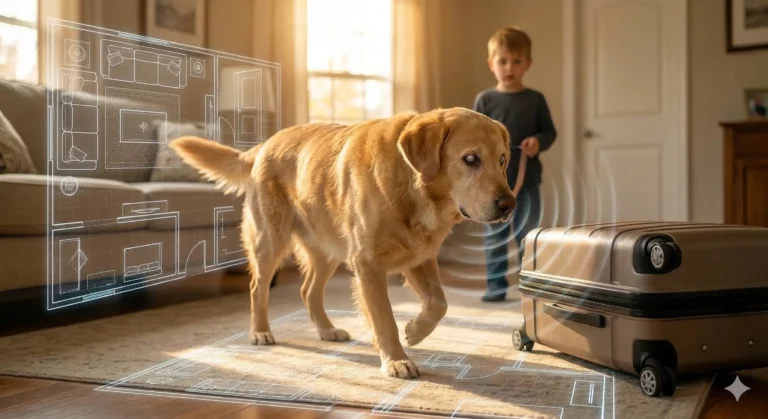
Echolocation for dogs works on the same principle as bats and dolphins. A small device on your dog’s collar emits ultrasonic pulses. These bounce off walls, furniture, trees, people, anything solid. Your dog hears the returning echoes and learns to “read” the space around them.Halo, Bumper or Sonar? Choosing the Right Aid
If you’ve been researching blind dog accessories, you’ve probably come across a few options. Here’s an honest breakdown.
Tip #12: Know your options before you buy
Halo and bumper rings (like Muffin’s Halo) are the most common. They’re plastic or foam rings that attach to a harness around your dog’s head. When the ring hits a wall, your dog knows to stop. They work, but only on contact, your dog still reaches the obstacle. They’re also bulky, which means your dog can’t eat, drink, or sleep comfortably while wearing one. Most owners end up taking them off and on constantly.
| Halo / Bumper Ring | Echo Smart Activ® | |
|---|---|---|
| Detection | On contact | Before contact (up to 3m) |
| Weight | 150-300g | 30g |
| Comfort | Bulky harness | Clips to collar |
| Eats / sleeps freely | Restricted | Yes |
| Battery | N/A | 3 months |
| Works in new places | Yes (on contact) | Yes (before contact) |
Outdoor Walks: Yes, Your Blind Dog Can Enjoy Them
When to See a Veterinary Ophthalmologist
- Cataracts — often surgically removable, especially in younger dogs. Success rates above 90% when done early
- Glaucoma — painful and progressive, but manageable with medication if caught in time
- SARDS (Sudden Acquired Retinal Degeneration) — irreversible, but important to confirm and rule out other causes
- Progressive Retinal Atrophy — genetic, irreversible, but slow. Your dog adapts gradually