
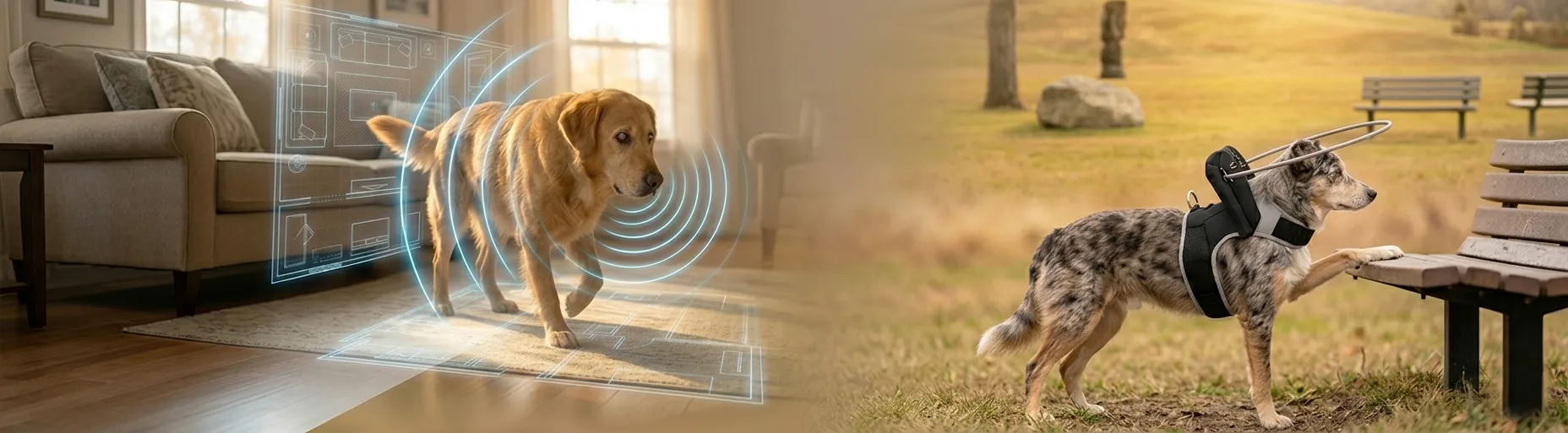
Blind dog halo vs echolocation sonar – comparison of blind dog solutions

Echolocation vs Halo: Which Is Best for Your Blind Dog?

Your dog went blind. Maybe it happened slowly, maybe overnight. Either way, you’re now spending your evenings searching for anything that might help. And you keep seeing the same two options come up: halos and echolocation devices.

One is a physical ring around your dog’s head that bumps into things before their face does. The other uses ultrasonic sonar to detect obstacles before your dog reaches them. They sound completely different, and they are. But which one actually works better for your blind dog?
I’ve tested both approaches. I lived with a blind golden retriever who tried halos, bumpers, and eventually echolocation. This article is the honest comparison I wish I’d found when I started looking. No hype, no bashing. Just what each solution does, where it works, where it doesn’t, and which one might be right for your dog.

The Problem Every Blind Dog Owner Faces

When your dog goes blind, everything changes. Familiar rooms become obstacle courses. A bag left on the floor, a chair moved slightly, a door closed that’s usually open — every small change means a collision. Some dogs bump into things daily. Others become cautious, moving slowly with their head low, unsure of what’s ahead.

Over time, many dogs memorize their home layout and get around more confidently. But that mental map is fragile. It only works in one place, and it breaks the moment something moves. Outside the home — a friend’s house, a park, the vet — there’s no map at all.
The core challenge is this: a blind dog can memorize a familiar, static world, but the world keeps changing. What really helps is a way to perceive surroundings in real time, not just remember where things used to be.
That’s where aids come in. And the two main categories, halos and echolocation devices, take fundamentally different approaches to solving this.

How Halos and Bumper Rings Work

The concept is simple and intuitive. A lightweight ring, usually made of plastic or foam-covered wire, extends out from your dog’s head or shoulders. When the ring contacts an obstacle, a wall, a table leg, a doorframe, the dog feels the pressure and stops before their face hits it.

Think of it like a bumper on a bumper car. It doesn’t prevent the collision entirely, it just makes sure the ring takes the hit instead of your dog’s nose or eyes.
Most blind dog halos attach to a harness that wraps around the dog’s chest and shoulders. The ring sits at head height, protruding a few centimeters in front and to the sides. Some designs use a single hoop, others use multiple rings at different heights.
The strengths are real: no batteries, no technology to learn, immediate protection from the moment you put it on. Your dog doesn’t need to learn anything. The ring does the work. For dogs who are walking into walls and furniture right now, a halo provides instant relief.
The limitations are equally real. The halo only works on contact. Your dog still reaches the obstacle. They still feel the bump, just through the ring instead of their face. There’s no advance warning, no “something is 2 meters ahead” signal. And because the ring adds bulk (typically 150 to 300 grams plus the harness), most dogs can’t eat, drink, or sleep comfortably while wearing it. Owners end up putting it on and taking it off multiple times a day.
Halos also don’t detect ground-level hazards, like steps, curbs, or objects below the ring. And in tight spaces, the ring itself can get caught on furniture or doorframes, which can stress some dogs.

How Echolocation Devices Work

Echolocation is the same principle that bats and dolphins use to navigate. A device emits ultrasonic pulses, sound waves above the range of human hearing. These pulses travel outward, bounce off solid objects, and return to the device. The device then produces an audible signal that changes based on the distance and position of the obstacle.
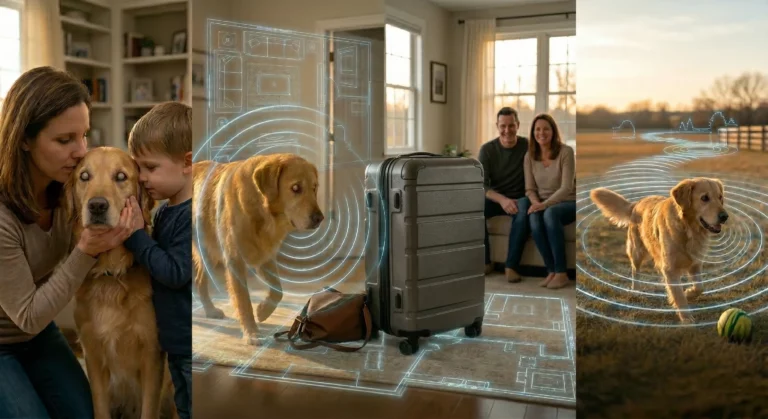
For dogs, this means they receive a continuous audio map of the space around them. An obstacle 3 meters away produces one kind of signal. The same obstacle at 1 meter produces a different one. The dog learns to read these changes the way a sighted dog reads visual cues, automatically and without conscious effort.
This approach has been studied in peer-reviewed research. Bhatt et al., published in the Journal of Veterinary Behavior, found that dogs using sonar-based devices had significantly fewer collisions and showed increased confidence in unfamiliar environments. The dogs didn’t just avoid obstacles. They navigated more fluidly, more like sighted dogs.
The concept is sometimes called blindsight: the ability to perceive and respond to the environment without conventional vision. In nature, many species rely on echolocation as their primary sense. For blind dogs, technology can replicate this principle.
The key difference from a halo is timing. A halo tells your dog “you’ve reached something.” An echolocation device tells your dog “something is ahead, and here’s how far away it is.” One is reactive. The other is proactive. That distinction changes how your dog moves through the world.
The learning curve is the trade-off. A halo works the instant you strap it on. An echolocation device requires a few days to a couple of weeks for your dog to learn what the sounds mean. Most dogs adapt faster than their owners expect, but it’s not instant.
Blind dog wearing an echolocation sonar device — detecting obstacles before contact

Muffin’s Halo: The Most Popular Halo

Muffin’s Halo is the most recognized name in blind dog halos, and for good reason. It’s been around for years, it has a loyal community of users, and it works exactly as advertised. If your dog is walking into walls, Muffin’s Halo will stop that from happening the day you put it on.

The design uses a lightweight ring attached to a harness-style vest. The ring extends in front of your dog’s face and to the sides, catching obstacles before your dog’s head makes contact. It comes in multiple sizes for different breeds, and the build quality is solid.

What Muffin’s Halo does well

It provides immediate, reliable contact protection. No learning period, no technology to configure, no batteries to replace. Your dog wears it, and it works. The community around Muffin’s Halo is also genuinely helpful. Owners share tips, photos, and encouragement. For someone who just found out their dog is blind, that community support matters.

Where Muffin’s Halo falls short

The limitations come from the fundamental design, not from poor execution. A physical ring can only protect against what it physically touches. That means:
On-contact only: your dog still reaches the obstacle. There’s no advance warning.
Weight: 150 to 300 grams depending on size, plus the harness. That’s significant for small dogs.
Can’t eat, drink, or sleep with it on: most owners remove it several times a day.
Ring can snag on furniture legs, doorframes, or tight spaces.
No detection below ring height: steps, curbs, and ground-level objects are missed.
None of this makes Muffin’s Halo a bad product. It’s the best version of what a halo can be. But a halo, by definition, is limited to contact-based protection. For some dogs and some situations, that’s enough. For others, it’s not.

Echo Smart Activ®: The Latest Generation

I built Echo Smart Activ® because I needed something that didn’t exist yet. My golden retriever had tried halos. They protected her face, but she was still navigating blind. She had no idea what was around her until she physically ran into it. I wanted her to know what was there before she reached it.

Echo Smart Activ® uses ultrasonic echolocation to detect obstacles up to 3 meters before contact. It weighs 30 grams and clips directly to your dog’s existing collar. No harness, no vest, nothing to put on and take off. Your dog wears their collar as usual, and the device stays on.
The “Smart Activ” feature means the device only activates when your dog is moving. When they’re resting, eating, or sleeping, it goes silent. This serves two purposes: it avoids unnecessary stimulation, and it extends the battery life to approximately 3 months on a single battery.
What changed for my dog was not just collision avoidance. It was spatial awareness. She didn’t just stop bumping into things. She started moving differently. She walked with her head up. She navigated around obstacles instead of into them. In new places, instead of freezing or clinging to me, she explored. The device gave her a continuous read of the space around her, a kind of sound vision that worked everywhere, not just at home.
The adaptation period varies by dog, but most learn to interpret the signals within a few days to two weeks. The step-by-step user guide walks you through the process from day one.
I’m not going to pretend I’m unbiased here. I created this product. But I created it because nothing else gave my dog what she needed: real-time awareness, minimal weight, and the ability to stay on 24/7 without affecting her daily life. The specs speak for themselves.

Full Comparison Table

Here’s how the two main available solutions compare.

 Muffin’s HaloEcho Smart Activ®
Detection methodPhysical contact (ring hits obstacle)Ultrasonic sonar
Range0 cm (on contact)Up to 3 meters
Weight150–300g + harness30g
MountingHarness vestClips to any collar
Comfort (eat/sleep)Must remove to eat, drink, sleepStays on 24/7 (auto-pauses at rest)
BatteryN/A (no electronics)≈3 months
Works in new placesYes (on contact only)Yes (before contact, up to 3m)
Price range∶60–100 USDSee current price
AvailabilityWidely availableAvailable worldwide
Support / CommunityActive community, good supportDirect support + FAQ

Which Solution Is Right for Your Dog?

There’s no single right answer. It depends on your dog, your situation, and what problem you’re actually trying to solve.

A halo might be the right choice if:

• Your dog is newly blind and walking into walls right now. A halo provides instant protection while you figure out the long-term plan.
• Your dog stays mostly at home in a familiar environment and rarely encounters new spaces.
• You want zero learning curve and zero technology to manage.
• Budget is a primary concern. Halos are the most affordable option.

An echolocation device might be the right choice if:

• Your dog goes to new places regularly: walks, parks, friends’ houses, travel.
• You want your dog to detect obstacles before reaching them, not just cushion the impact.
• Your dog is uncomfortable with the bulk of a harness and ring, especially small dogs.
• You want something that stays on 24/7 without affecting eating, drinking, or sleeping.
• You’re willing to invest a few days in the learning period for a long-term gain in independence.

Can you use both?

Yes. Some owners start with a halo for immediate protection and add an echolocation device once their dog has adjusted to being blind. Others use a halo in specific high-risk situations (near stairs, for example) and the sonar device for everything else. There’s no rule that says you have to choose one.
What matters is understanding what each tool does and doesn’t do. A halo will always be limited to contact-based protection. An echolocation device will always require a short learning period. Neither is perfect. Both help.
If you want to go deeper into the day-to-day of living with a blind dog, I put together 12 practical tips for living with a blind dog that covers everything from home setup to outdoor walks.

Final Thoughts

When my golden retriever went blind, I tried everything. Halos, bumpers, voice commands, furniture rearrangement, scent markers. Some things helped more than others. None of it was wasted effort. Every tool that reduces even one collision per day is worth considering.

But the moment that changed everything was when she started perceiving space again. Not just memorizing it, not just bumping into it more gently, but actually knowing what was around her before she got there. She walked differently. She held her head up. She explored instead of freezing. She was herself again.
That’s what I built Echo Smart Activ® to do. Not because halos are bad, they’re not. But because I believe blind dogs deserve more than contact protection. They deserve awareness. They deserve to move through the world with confidence, not caution.
She’s gone now, my golden girl. But everything I learned from her is in this device. Every test, every iteration, every late night tweaking the sensitivity because she’d nudge me when something wasn’t right. Echo exists because of her.
If your dog is blind and you’re not sure where to start, start anywhere. A rug at the bottom of the stairs. A consistent voice command. A halo. A sonar device. The fact that you’re reading this means you care enough to find a way. Your dog is lucky to have you.
Wondering if a blind dog can still be happy? The answer might surprise you.

Leave a Reply

Your email address will not be published. Required fields are marked *